




In today’s manufacturing landscape, companies are under pressure to produce more, to higher standards, whilst facing increasing difficulties in recruiting skilled workers. Against this backdrop, industrial robotic automation is no longer merely an opportunity for growth, but a strategic lever for maintaining competitiveness, production continuity and efficiency.
Among the technologies that are transforming the way in which material handling and feeding processes on production lines are managed, industrial bin picking is playing an increasingly central role. Thanks to the combination of industrial robots, 3D vision systems and advanced data processing software, it is now possible to automate the picking of components arranged randomly inside bins or containers, thereby reducing time, costs and reliance on manual operations.
But how does a bin-picking robot system actually work? What advantages does it offer? What is the return on investment? And why is this technology increasingly being integrated into CNC automation and machine tool tending projects?
In this in-depth guide, we will examine all the key aspects of modern bin picking, from the technologies used to its impact on productivity, sustainability and ROI.
Indice dei contenuti
ToggleWhat is industrial bin picking and what problems does it solve?
Bin picking is a technology that enables a robot to automatically identify, select and pick up parts stored in bulk inside a container.
Unlike traditional handling systems, which require components to be precisely oriented and positioned, bin picking is designed to cope with highly random situations.
L’obiettivo è consentire al robot di:
- identify the correct part;
- to determine its three-dimensional position;
- calculate the best gripping strategy;
- transfer the component to a machining operation, an inspection station or a pallet.
This technology was developed to address problems that are very common in modern production facilities:
- repetitive manual handling;
- loading and unloading of CNC machine tools;
- palletising of metal components;
- automatic feeding of production lines;
- reduction in the physical strain on operators.
The result is a faster, safer and more controllable process.
How does a bin-picking robot system work?
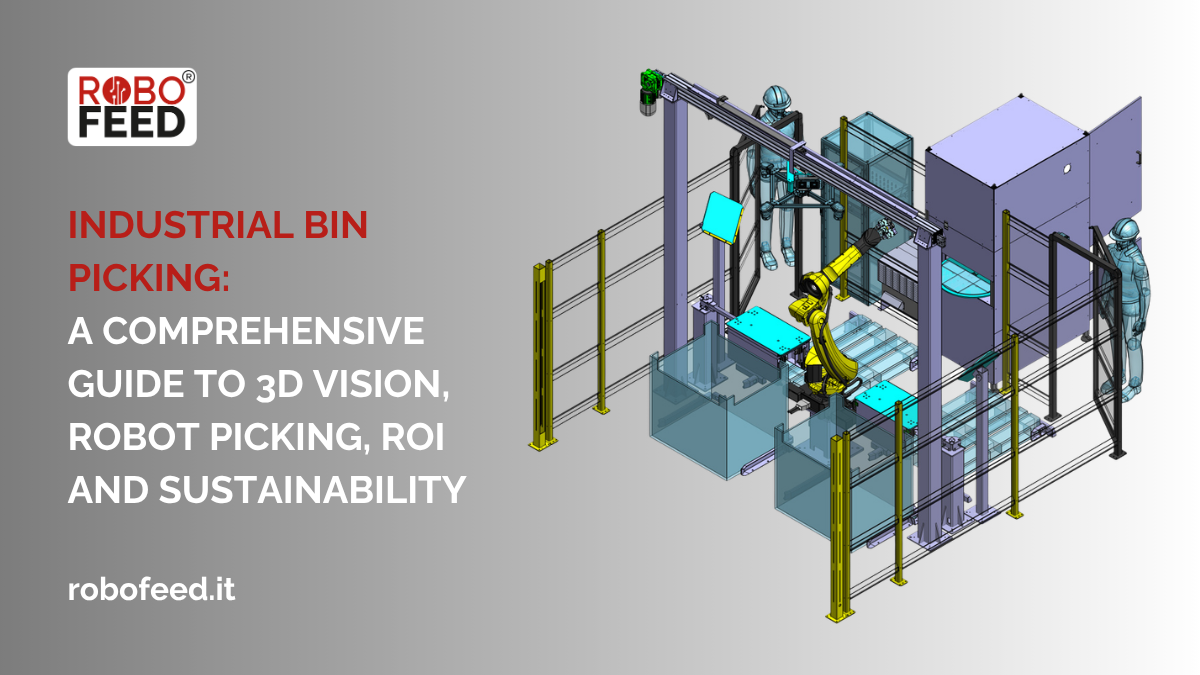
A modern bin-picking robot system consists of three main components:
- 3D vision system;
- processing software;
- industrial robot with a gripping system.
The interaction between these elements makes it possible to fully automate the picking process.
Image acquisition using 3D vision
The first step is to scan the container.
Modern industrial 3D vision systems use advanced cameras and structured light to generate an extremely accurate three-dimensional representation of the contents of the container.
Compared with early applications, which required laser scanners mounted on linear axes, current technologies make it possible to capture large amounts of data in a matter of moments, thereby increasing both accuracy and operational speed.
Coordinate processing
Once the three-dimensional image has been captured, the software identifies the components present and determines:
- position;
- guidance;
- inclination;
- accessibility of the part.
The algorithm then selects the component that offers the best chance of a successful catch.
Calculation of the robotic trajectory
The software automatically calculates the safest and most efficient route.
The following are avoided:
- collisions with the body;
- impact with other components;
- configurations that the robot cannot reach.
Collection and transfer
The robot picks up the part and transfers it to its intended destination:
- CNC machine;
- marking system;
- quality control station;
- pallet;
- assembly line.
The entire process takes place without human intervention.
The evolution of 3D vision in bin picking
For many years, bin picking was regarded as a complex technology intended for only a few specialist applications.
The real leap in quality came about thanks to three key factors:
High-performance 3D sensors
Modern sensors (such as those found on Keyence vision systems) enable an accurate representation of the scanned volume to be obtained without the need to move the scanning system.
This improves:
- speed;
- precision;
- reliability of the grip.
Greater computing power
Industrial computers today are capable of processing huge amounts of data in an extremely short time.
The trajectories are calculated almost in real time, making it possible to use bin picking even in high-throughput applications.
SOFTWARE EVOLUTION
Robotic recognition and planning algorithms have reached a level of maturity that enables them to tackle applications considered unfeasible until just a few years ago.
For this reason, bin picking is now a practical and affordable solution for many manufacturing companies.
Bin picking and CNC automation: an increasingly strategic combination
One of the areas in which bin picking is most widely used is machine tool automation.
Many companies have to manage repetitive loading and unloading tasks at machining centres, often with components arranged haphazardly in containers.
In such cases, a servo-robot system can:
- to feed the machine automatically;
- to ensure continuity of production;
- reduce downtime;
- to support unmanned operations.
The integration of bin picking and CNC automation makes it possible to increase the effective machine utilisation time and improve the overall efficiency of the plant.
For this reason, bin picking is now one of the most advanced applications in the field of industrial automation and robotics.
The main advantages of industrial bin picking
- Reduced handling times – Picking operations are carried out quickly and consistently, eliminating the variability typical of manual tasks.
- Greater production continuity – The systems can operate for long periods without direct supervision, whilst maintaining high levels of productivity.
- Reduction in labour costs – Operators can be assigned to tasks with higher added value rather than repetitive handling tasks.
- High precision – 3D vision systems enable the robot to operate with great accuracy, even in complex environments.
- Operator safety – Reducing manual tasks limits exposure to repetitive movements, awkward postures and potentially hazardous operations.
- Management of multiple containers – A single system can operate on multiple containers holding different components, switching automatically between them as required.
How much does a bin-picking system actually generate? An analysis of the ROI
When evaluating an automation project, the main question is always about the return on investment.
In the case of bin picking, the ROI is the result of a combination of various factors.
Increased productivity
The robot maintains consistent performance throughout the entire production shift, without any slowdowns or variations due to fatigue.
Reduction in machine downtime
The machines are fed continuously, thereby reducing downtime.
Less reliance on the availability of staff
In a market characterised by increasing difficulty in recruiting specialist staff, this represents a key competitive advantage.
Improved process quality
The repeatability guaranteed by the system helps to reduce errors and rework.
Greater utilisation of the facilities
Companies can also extend production to unmanned or partially manned shifts.
In most applications, these benefits generate a measurable financial return within the first few years of use.
Bin picking and sustainability: an often-overlooked benefit
When it comes to industrial sustainability, the focus is often on the energy consumption of machinery.
In fact, bin picking contributes to sustainability in a number of ways:
- Reduction in waste – A more precise grip reduces errors, damage and rework.
- Better use of resources – Automation enables the optimisation of time, materials and production capacity.
- Improved working conditions – Operators are relieved of the heaviest and most repetitive tasks, fostering a more ergonomic working environment that focuses on higher-value skills.
- Greater efficiency across the entire production process – Reducing inefficiencies contributes to a more rational use of the company’s resources.
For this reason, bin picking is increasingly becoming part of innovation initiatives guided by the principles of sustainable industry.
Case study: how ROBO FEED achieved a 99% bin emptying rate
A concrete example of the effectiveness of this technology is the project developed by ROBO FEED for HT Srl, a company specialising in the manufacture of components for agricultural machinery.
The aim was to automate the retrieval of metal blades stored in bulk inside two containers and then to palletise them onto two different pallets.
The solution implemented comprised:
- 3D vision-based bin-picking system;
- Fanuc M20iD-25 robot;
- software-controlled magnetic gripper;
- integration with the LASIT laser marking machine;
- proprietary software for managing palletising strategies.
The results achieved exceeded the initial targets:
| Parameter | Objective | Result |
| Cycle time | 15 seconds | Less than 12 seconds |
| Emptying of skips | 97% | 99% |
| Productivity | Could be improved | Increased |
| System integration | Request | Complete |
The solution has made it possible to significantly reduce manual operations, whilst improving production continuity and process reliability.
How to assess the feasibility of a bin-picking project
Not all applications are equally complex.
Factors affecting feasibility include:
- geometry of the workpiece;
- dimensions of the component;
- material;
- type of socket required;
- dimensions of the body;
- required cycle time;
- desired percentage of emptying.
For this reason, specialist firms normally carry out a preliminary study that enables them to simulate the system’s behaviour before the final installation.
This stage enables us to estimate accurately:
- cycle times;
- expected performance;
- cell layout;
- type of robot;
- the most suitable gripping system;
- expected ROI.
Why choose a partner specialising in industrial robotic automation
A bin-picking system is not simply a robot fitted with a camera.
This is an integrated solution that combines robotics, software, machine vision, safety and in-depth knowledge of production processes.
ROBO FEED develops bespoke solutions for the manufacturing industry, with particular expertise in machine tool tending, CNC automation and the integration of Fanuc industrial robots.
Through feasibility studies, preliminary simulations and bespoke design, it is possible to identify the configuration best suited to the company’s production requirements, thereby reducing investment risks and maximising the project’s financial return.
Conclusion
Industrial bin picking is now one of the most advanced applications of industrial robotics. Thanks to advances in 3D vision, computing power and control software, it is now possible to automate operations that, until just a few years ago, necessarily required human intervention.
For companies seeking to boost productivity, operational continuity and competitiveness, bin picking is a practical, quantifiable technology capable of delivering tangible benefits both in economic terms and in terms of sustainability.
We invite you to contact the ROBO FEED team to identify the solution best suited to your production process and to assess the automation options for your business.
FAQ
Industrial bin picking is a technology that enables a robot to automatically identify and pick components arranged randomly inside a bin or container using 3D vision systems.
Bin-picking applications generally use industrial anthropomorphic robots, such as Fanuc robots, which are selected on the basis of payload, reach and production requirements.
Yes. One of the main applications of bin picking is to integrate with CNC machine tools already in use within the company, without necessarily having to modify the existing system
It depends on the type of part and the application. In the most advanced systems, it is possible to achieve emptying rates of over 99 per cent.