




When we talk about CNC retrofits, we often think of replacing the numerical control system or upgrading the machine’s electronics. In reality, the concept is much broader.
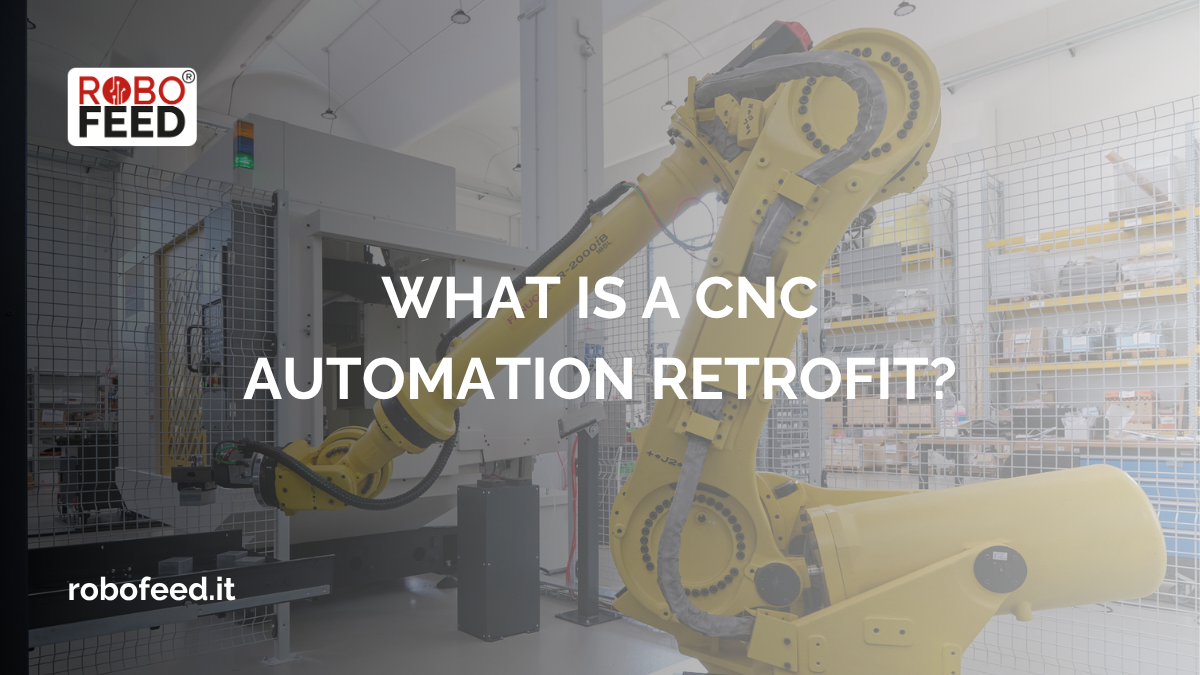
In the case of machine tool automation, retrofitting involves integrating automatic loading and unloading systems, collaborative robots or industrial robots, and management software into machines already present in the workshop, without altering their primary function.
In other words, the machine continues to produce parts that meet the required specifications, whilst eliminating many of the manual tasks that currently limit productivity.
It is an increasingly popular solution because it allows companies to make the most of investments made in previous years, extending the useful life of the machinery and ensuring it remains compatible with current production requirements.
Indice dei contenuti
ToggleMechanical, electronic or automation retrofits: they are not the same thing
To avoid any misunderstanding, it is useful to distinguish between three types of intervention.
Mechanical retrofit
It involves replacing components subject to wear and tear, such as guide rails, recirculating ball screws, spindles or drive systems, with the aim of restoring the machine to its original performance.
Electronic retrofit
This concerns the upgrading of the numerical control system, the drives or the electrical system, thereby improving reliability and the availability of spare parts.
Automation retrofit
This is the measure of greatest interest to companies seeking to increase productivity.
The aim is not to alter the way the machine tool operates, but to automate all those repetitive tasks that currently require the continuous presence of an operator. It is precisely this approach that makes it possible to introduce collaborative robotics systems, servo robots and automated cells even on machines that have been in place for many years.
Why are more and more companies choosing to automate their existing machinery?
In recent years, the manufacturing sector has had to face increasingly complex challenges.
The main ones include:
- difficulty in recruiting qualified staff;
- increase in production costs;
- the need to reduce cycle times;
- a call for greater production flexibility;
- ever smaller and more customised batches.
In this situation, buying a new car is not always the best solution.
In fact, many workshops have CNC lathes or machining centres that are perfectly efficient from a mechanical point of view, but are hampered by the need for manual loading and unloading.
This is where retrofitting offers the greatest benefit: rather than replacing a machine that is still performing well, it eliminates the bottleneck caused by manual operations.
The result is an automatic loading and unloading system capable of operating for several consecutive hours, with greater continuity and improved machine utilisation.
When is it really worth retrofitting CNC automation?
There is no one-size-fits-all answer for all companies.
Cost-effectiveness depends on a number of technical, economic and organisational factors, which should be assessed as a whole.
1. The machine is still mechanically reliable
A car’s registered age matters far less than its actual condition.
It is not uncommon to find machining centres installed over fifteen years ago that are still perfectly accurate and reliable, thanks to regular maintenance.
If the quality of the work remains high and the machine still delivers the required precision, replacing it may not be economically justified.
Automating it, on the other hand, makes it possible to increase its output without having to give up a production asset that is still fully efficient.
2. The real limitation is the operator, not the machine
This is probably the most common situation.
Many CNC machines complete the machining cycle in a matter of minutes, but remain idle whilst waiting for an operator to:
- remove the finished piece;
- carry out a check;
- position the next piece;
- Restart the programme.
Even a few minutes of inactivity, repeated hundreds of times throughout the day, have a significant impact on overall productivity.
The introduction of a system of robots to assist machine tools, on the other hand, makes it possible to automate these operations, drastically reducing non-productive time.
In many cases, the improvement is not due to faster processing, but simply to the fact that the machine remains operational for much longer.
3. The workshop is struggling to find qualified staff
Finding experienced CNC operators is now one of the main challenges facing many companies.
Automation retrofitting does not replace human skills, but allows them to be used where they generate the most value.
The operator can carry out tasks such as:
- quality control;
- programming;
- equipment;
- production management;
- monitoring of several machines at the same time.
Repetitive tasks, on the other hand, are carried out by the robotic system, improving work organisation and boosting the workshop’s overall efficiency.
4. We want to increase productive hours without expanding the department
Expanding a factory or purchasing new machinery requires significant investment.
When space is limited, retrofitting makes it possible to increase production capacity by making better use of existing facilities.
Automation makes it possible to:
- prolonged processing;
- evening productions with reduced supervision;
- greater continuity between one cycle and the next;
- better use of the machine throughout the day.
The aim is not to have the robot do people’s jobs, but to enable the machine to produce for a greater number of genuinely productive hours.
5. The return on investment is quicker
One of the most interesting aspects concerns ROI.
Buying a new machine tool involves significant costs, including:
- purchase of the system;
- transport;
- installation;
- training;
- any installation works;
- production stoppage.
Automation retrofitting, on the other hand, involves work on an existing infrastructure.
This often makes it possible to reduce both the initial investment and the time needed to start production with the new automated system. Of course, every project requires a specific analysis, but it is precisely this difference that makes retrofitting a particularly attractive solution for many SMEs wishing to boost productivity without having to completely overhaul their machinery.
It’s not the machine that’s old. It might be the process.
One of the most common mistakes is to automatically link a machine’s age to its production capacity.
In fact, in many workshops, the real factor limiting performance is not the machining centre itself, but the process surrounding it.
A precise, reliable and properly maintained CNC machine can continue to generate value for many years. If the cycle time is already competitive and the quality of the workpiece meets the specifications, replacing it simply to introduce automation risks being a disproportionate investment. Conversely, integrating an industrial robotic automation system makes it possible to eliminate most low-value-added tasks, transforming an existing machine into a much more productive asset without altering its fundamental characteristics.
In many cases, therefore, there is no need to start from scratch: it is simply a matter of rethinking the way the machine operates within the production process.
CNC automation retrofit or a new machine? The comparison every company should make
When considering a major investment, the question should not be ‘How much does a new car cost?’, but rather ‘Which option offers the best return on investment?’.
That is a significant difference.
Purchasing a new machining centre is often a necessary step when the existing machine no longer guarantees adequate precision, reliability or performance. In many other cases, however, the problem does not lie with the machine itself, but with the level of automation in the process.
Before making a decision, it is therefore worth comparing the two scenarios objectively.
Initial investment
A new machine tool represents an investment that goes far beyond the purchase price. Factors such as transport, installation, system upgrades, operator training and, not infrequently, changes to the production layout must be taken into account.
With a CNC automation retrofit, on the other hand, you can make the most of equipment already in place at the company. The investment focuses on integrating the robotic system, whilst keeping the existing machine operational and significantly reducing the costs associated with replacing the entire system.
Implementation times
Installing a new machine can take weeks or months, taking into account ordering, delivery, commissioning and the start of production.
A project to automate existing machinery, if well planned, generally helps to minimise downtime and enables a rapid return to full operation.
For companies that operate on a contract basis or have high production volumes, this factor can be just as significant as the cost of the investment.
Business continuity
Every new machine requires a period of adjustment: programming, staff training, verification of production cycles and process optimisation.
In a retrofit, on the other hand, operators continue to work on a machine they are already familiar with. It is the way the workpiece is handled that changes, not the expertise they have built up over the years.
This reduces the time needed to reach full production capacity.
Future flexibility
Another advantage that is often underestimated is the ability to develop automation over time.
Modern robotic cells are designed to adapt to different production processes, making it possible to handle new components without having to completely redesign the system.
For companies that produce small and medium-sized batches, this flexibility represents a significant competitive advantage.
The 5 questions to ask yourself before buying a new CNC machine
Many investment decisions are made on the basis of a false assumption: if productivity is not high enough, then a new machine is needed.
In fact, before allocating resources to a new plant, it is worth taking a step back and analysing the process as a whole.
1. Is the machine still producing parts that meet the required tolerances?
If the answer is yes, the core of the production process continues to function correctly.
Replacing a machine that is still accurate may not be the most cost-effective option.
2. How long does it actually remain stationary between one cycle and the next?
Many companies find that the machine is only actually in production for a few hours during a shift.
The rest of the time is taken up by manual tasks, workpiece changes, handling and waiting.
Automating these stages can lead to surprising gains in productivity without altering the production cycle.
3. Is the bottleneck the machine or the loading/unloading process?
It’s a simple question, but often a crucial one.
If the spindle remains stationary whilst waiting for the operator, the problem is probably not the machine’s capacity, but the management of the production flow.
4. How much does the production stoppage required to install a new system actually cost?
In addition to the price of the machine, one must take into account the cost of lost production, any delays in deliveries and the time needed to return to full capacity.
These factors also have an impact on the return on investment.
5. Is the investment scalable?
Many companies prefer to spread their investments over time.
Starting with the automation of a key machine makes it possible to measure the benefits achieved in concrete terms and, subsequently, to extend the project to other machines in the workshop.
It is a progressive approach that reduces risk and makes it easier to plan investments.
Which CNC machines can be automated?
One of the most widespread beliefs is that only the latest-generation systems can be integrated with robotic systems.
In fact, in most cases, it is possible to automate machines that have been in operation for years, provided they are mechanically reliable and suitable for the type of machining involved.
Every project naturally requires a preliminary analysis, but there are far more applications than one might imagine.
Among the machines that are most frequently automated are:
- CNC lathes;
- vertical machining centres;
- horizontal machining centres;
- multi-tasking machines;
- production cells comprising several machines.
The aim is not to replace the existing process, but to make it more efficient through the use of automated parts-handling systems.
Industrial robot or cobot? The choice depends on the application
In recent years, developments in collaborative robotics have profoundly changed the way we think about the automation of machine tools.
Whilst in the past it was necessary to design completely segregated cells, today many applications can be carried out using cobots that share the workspace with operators, in compliance with safety regulations and the required risk assessments.
This makes retrofitting much simpler than it used to be.
The main advantages are clear:
- compact dimensions;
- greater ease of integration;
- short installation times;
- intuitive programming;
- the ability to reconfigure production quickly.
For this reason, collaborative robotics is now one of the most interesting technologies for SMEs wishing to automate their machinery without radically changing the way their department is organised.
The role of FANUC robots in CNC automation
When it comes to robots for machine tools, reliability and operational continuity are key factors.
This is why many companies opt for solutions developed by manufacturers with extensive experience in industrial automation.
FANUC CRX collaborative robots, for example, are designed for machine loading and unloading applications, ensuring precision, repeatability and ease of programming. When integrated into a well-designed automated cell, they enable the automation of repetitive machining operations whilst maintaining a high level of production flexibility.
Of course, the robot is just one element of the system. What really makes the difference is the integration between the robot, the machine tool, the gripper systems, the safety systems and the management software – all designed to work as a single ecosystem.
It is precisely this integration that enables concrete results to be achieved in terms of productivity, reliability and the reduction of downtime.
Retrofitting doesn’t mean adding a robot. It means rethinking the process.
One of the most common mistakes is to view the robot as an accessory to be installed alongside the machine.
In fact, an effective CNC automation project stems from an in-depth analysis of the production cycle.
The aim is not simply to automate the loading and unloading of the workpiece, but to eliminate the inefficiencies that slow down the entire process: waiting times, unnecessary handling, sub-optimal management of equipment and intermittent use of the machine.
For this reason, every retrofit should be designed with the workshop’s production flows in mind, rather than the robot’s specifications.
When automation is approached from this perspective, the result is not just a more modern machine, but a smoother, more predictable and more competitive process.
How to develop a CNC automation retrofit project
One of the factors that most often holds companies back is the perception that a retrofit requires complex work, lengthy periods of machine downtime or radical changes to the existing system.
In practice, a well-planned project follows a structured process designed to minimise the impact on production and maximise the return on investment.
Rather than simply installing a robot, it is a question of designing a solution that can be integrated into the workshop’s day-to-day operations.
1. Analysis of the production process
Every machine has different characteristics, constraints and operating procedures.
For this reason, the first step is to analyse the production cycle, identifying where unproductive time is concentrated and which activities can be automated without compromising production flexibility.
At this stage, factors such as the following are assessed:
- cycle times;
- frequency of production changes;
- type of workpieces;
- set-up procedures;
- available spaces;
- integration with the numerical control system.
The aim is not to propose a standard solution, but to identify the one best suited to the company’s actual needs.
2. Design of the robotic cell
Once the automation strategy has been defined, the next step is to design the cell.
This is where all the elements that make up the system come into play:
- collaborative robot or industrial robot;
- gripping systems;
- parts warehouses;
- safety devices;
- management software;
- interface with the CNC machine.
Careful design makes it possible to make the best use of the available space and to create a solution that is easy for operators to use.
For this reason, no two retrofits are ever truly identical: each project is tailored to the specific production context.
3. Installation and integration
The installation phase is planned to minimise production downtime as much as possible.
The integration of robots and machine tools is one of the most challenging aspects of the project, as it must ensure reliability, safety and operational continuity.
A well-designed system enables operators to interact easily with the cell, whilst maintaining the high level of flexibility required to handle different production runs.
4. Testing and training
This final step is not just about ensuring the system works properly.
It is essential that staff familiarise themselves with the new system, learning to manage day-to-day production easily and independently.
Modern collaborative robotics solutions are specifically designed to be intuitive to use, reducing the learning curve and making it easier to integrate them into day-to-day workshop operations.
The most common mistakes when evaluating a CNC retrofit
Every industrial investment should be based on hard data rather than on long-held beliefs.
And yet, when it comes to automation, there are still a number of misconceptions that risk leading to decisions that are not in one’s best interests.
To think that an outdated machine cannot be automated
As we have seen, the age of the machine is not the main criterion.
Many machining centres that were installed over ten or fifteen years ago continue to offer a high level of precision and reliability. Whilst their main limitation is manual loading and unloading, a retrofit can be an extremely effective solution.
Consider only the initial cost
Simply comparing the price of a new machine with that of a retrofit often results in an incomplete analysis.
The following should also be taken into account:
- increase in productivity;
- reduction in downtime;
- greater use of the machine;
- plant downtime costs;
- return on investment periods.
The value of a project is measured over time, not just by its initial cost.
Look for a standard solution
Every workshop has different processes, products and objectives.
A solution that works well for a vertical machining centre may not be the best choice for a CNC lathe producing small batches with a high degree of variability.
For this reason, it is essential always to start with an analysis of the process rather than a product catalogue.
Consider the robot as the end goal
The robot is a tool, not the end result.
What creates value is the ability of the entire system to make the production process more efficient, reduce downtime and free operators from repetitive tasks.
The difference between a simple installation and a truly effective project lies precisely in the integration of technology, processes and work organisation.
ROBO FEED: automation for your production process
Every workshop has its own characteristics, just as every machine tool has its own specific capabilities and limitations.
For this reason, an effective retrofit project does not stem simply from the choice of a robot, but from an in-depth analysis of the production process and the company’s objectives.
ROBO FEED develops CNC automation solutions designed to integrate with existing machinery, creating bespoke automation cells that enable productivity to be increased without replacing systems that are still fully operational.
If you’re considering how to increase your workshop’s production capacity, the first step isn’t to choose a robot, but to work out which solution will offer the best return on your investment.
FAQ
CNC automation retrofitting involves integrating robotic systems, loading and unloading devices, and management software into existing machine tools, thereby improving their productivity without replacing the entire system.
Retrofitting is generally cost-effective when the machine is still mechanically reliable, but productivity is hampered by repetitive manual tasks, downtime or difficulties in recruiting skilled operators.
In most cases, CNC lathes, vertical and horizontal machining centres, multi-tasking machines and other machine tools that meet the technical requirements for integration with a robotic cell can be automated.
It depends on the condition of the machine and the production targets. If the system is still accurate and reliable, retrofitting the automation may be a quicker and more cost-effective solution for increasing productivity.
The timeframe varies depending on the complexity of the application. Following a preliminary analysis, it is possible to draw up an integration plan designed to minimise production downtime.