




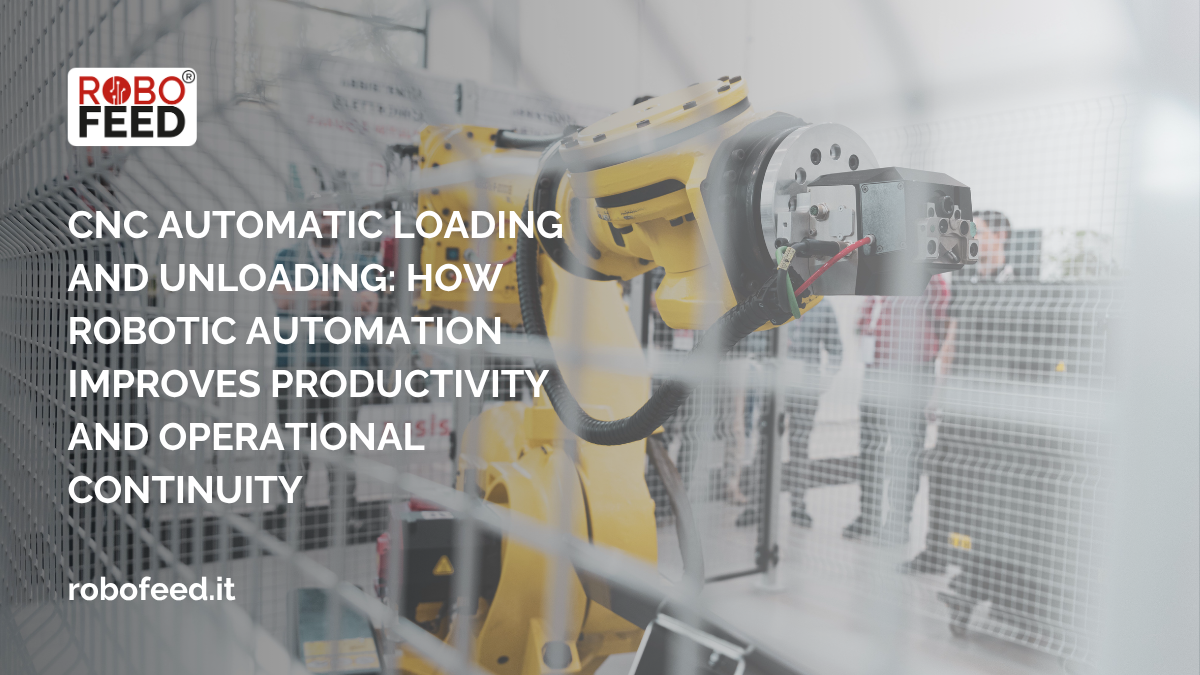
In the modern manufacturing sector, reducing downtime and improving operational continuity has become a top priority for many engineering workshops and production departments. Against this backdrop, automatic CNC loading and unloading is one of the most sought-after applications in the field of machine tool automation.
The integration of CNC industrial robots into production environments makes it possible to automate workpiece handling operations, thereby improving productivity, process repeatability and machine tool utilisation.
More and more companies are opting for robotic handling systems to transform CNC lathes and machining centres into automated systems capable of operating with greater continuity and fewer interruptions.
For many manufacturing companies, the transition from manual handling to a robotic system is not merely a technological upgrade, but a genuine organisational transformation.
Indice dei contenuti
ToggleWhat is meant by automatic CNC loading and unloading?
The term ‘CNC automatic loading and unloading’ refers to all robotic solutions designed to assist machine tools.
The system automates tasks such as:
- removal of the blank
- loading into the machine
- unloading the machined part
- pallet or tray handling
- automatic component sorting
- continuous production feed
These applications form part of the wider field of industrial robotics and automation and are used on both new and older machine tools.
Modern robotic solutions for machine tools can be integrated into:
- CNC lathes
- vertical and horizontal machining centres
- milling machines
- transfer
- grinding
- and many other types of machining
The aim is to optimise the production flow and reduce downtime between processing stages.
The benefits of robotic automation in CNC machines
Increased productivity
One of the main advantages of CNC loading and unloading is the increase in productivity.
In a manual process, the operator must stop the machining operation to open the machine, remove the machined workpiece, load the next one and restart the cycle.
With a robotic system, these operations are automated and synchronised with the CNC, drastically reducing downtime.
The result is a more efficient machine tool, with a higher proportion of time actually spent on production.
In many applications, CNC automation also makes it possible to:
- increase the number of units produced
- improve engine oxygen saturation
- extend production shifts
- operate in semi-supervised or unsupervised mode
- standardise repetitive tasks
For production managers, this translates into better resource management and greater competitiveness.
Business continuity and reduced downtime
Industrial robotic automation solutions enable production rates to be maintained at a constant level.
An industrial robot designed for tending can operate continuously, maintaining a high degree of repeatability even over extended cycles.
This aspect is particularly important in production:
- at high volumes
- multi-shift
- with a high degree of repeatability
- characterised by frequent loading and unloading
Business continuity also helps to reduce bottlenecks and production delays.
CNC industrial robots: what solutions are used
In the field of industrial automation and robotics, various types of robots are used to assist machine tools.
The choice depends on factors such as:
- workpiece weight
- cycle time
- production layout
- number of machines to be serviced
- type of processing
- available space
Among the most common solutions are:
Industrial robots
They are among the most widely used systems in the Italian industrial robotics sector.
They guarantee:
- high flexibility
- plenty of room to move
- positioning accuracy
- capability of serving multiple machines
Fanuc robots are one of the most widely used standards in CNC automation, thanks to their reliability and integration with industrial systems.
Cobots and collaborative robotics
In certain manufacturing environments, particularly where space is limited or greater interaction with the operator is required, collaborative robotics solutions are employed.
Cobots offer an attractive solution for flexible production, small batches or applications involving frequent format changes.
Machine tool automation: when is it really worth it?
Many companies still associate robotic automation with large-scale production or highly structured facilities.
In fact, robotic industrial automation solutions are now beneficial even for small engineering workshops.
Automation can be particularly effective when:
- loading and unloading times affect the cycle time
- the machine is often left idle, waiting for the operator
- staff must monitor several machines at the same time
- the aim is to increase the number of shifts without proportionally increasing the workforce
- we produce batches of any medium to large size
- we wish to standardise the process
In many cases, robotic automation makes it possible to get the most out of CNC machines already in the workshop, without necessarily needing to replace the existing machinery.
The importance of integration between CNC systems and robots
One of the most challenging aspects of CNC automation concerns the integration of robots and machine tools.
To achieve a truly efficient system, simply installing an industrial robot is not enough: a precise interplay between automation, CNC and production logic must be established.
For this reason, it is essential to work with partners who have expertise in both robotic automation and the machine tool industry.
The integration may include:
- PLC interfacing
- cycle synchronisation
- alarm management
- machine safety
- handling of clamps and tools
- vision systems
- integration with MES or ERP
Companies specialising in industrial automation and robotics can also tailor the system to the workshop’s production layout and operational requirements.
CNC automatic loading and unloading and operational safety
Automating loading and unloading also helps to improve the operational management of repetitive tasks.
The use of servo robots makes it possible to reduce the need for manual intervention in continuous parts handling operations, particularly where:
- heavy components
- highly repetitive cycles
- labour-intensive production
- continuous processing
Furthermore, modern robotic systems are designed in accordance with industrial safety standards and integrated into production cells in line with specific application requirements.
The role of industrial robotics in the future of manufacturing
The growing prevalence of robotics is transforming the way companies manage production.
In the metalworking sector, robotic automation is now a practical tool for:
- improve efficiency
- reduce downtime
- improve the quality of the process
- optimise the use of machine tools
- make production more scalable
The future of industrial robots will increasingly focus on flexible, integrated systems that can be easily adapted to production requirements.
For this reason, automatic CNC loading and unloading is no longer regarded merely as a technological investment, but as a strategic tool for boosting competitiveness.
ROBO FEED: robot feeding solutions for machine tools
ROBO FEED develops solutions for machine tool automation and CNC control systems, with systems designed to enhance productivity, operational continuity and industrial integration.
Drawing on its extensive experience in the fields of CNC machining and industrial robotics, ROBO FEED develops robotic systems designed to meet the practical production needs of engineering workshops.
The solutions can be integrated into various types of machine tools and configured according to:
- type of part
- production layout
- cycle time
- required range
- production flows
The aim is to provide reliable, flexible systems designed to maximise production efficiency.
Conclusion
CNC automatic loading and unloading is now one of the most practical and effective applications of industrial automation.
Through industrial robots, motion control systems and intelligent integration between CNC and automation, companies can improve productivity, enhance operational continuity and optimise the utilisation of machine tools.
For production managers and workshop supervisors, investing in robotic automation means creating a production department that is more efficient, flexible and ready to meet the demands of the modern market.
Contact the ROBO FEED team to assess the solution best suited to your production process and explore the automation options for your workshop.
FAQ
CNC automatic loading and unloading uses industrial robots or automated systems to handle workpieces within machine tools. The system picks up the raw component, positions it in the CNC machine and removes the machined part, thereby automating repetitive tasks.
Robotic handling solutions can be integrated into CNC lathes, machining centres, milling machines, transfer machines, grinding machines and other types of machining equipment, whether on new or existing machine tools.
Automation is particularly beneficial when loading and unloading times affect the production cycle, the machine is frequently idle, or there is a need to increase productivity without proportionally increasing the workforce.
Yes, many CNC automation solutions can also be installed on machine tools already in the workshop, enhancing the value of existing equipment through robotic integration and CNC interfacing.