




In the current landscape of machine tool automation, production models are changing rapidly.
The limitations of traditional CNC automation are becoming increasingly apparent: ever-smaller batches, a high mix of part numbers and the need for continuous reconfiguration render the solutions offered by traditional machine tool robots—designed for stable, repetitive production—ineffective.
For a plant manager or system integrator, this translates into:
- loss of efficiency
- increased set-up times
- difficulties in managing multi-product production
In this context, it is no longer enough to focus solely on machine tending: it is necessary to rethink the entire management of the production process.
Indice dei contenuti
ToggleModular robotic cells and CNC automation: what really changes
Modular robotic cells now offer an effective solution for CNC machine tending.
These industrial robotic automation solutions enable you to:
- automate loading/unloading operations
- integrate industrial robots into manufacturing processes
- improve operational continuity
However, when production becomes complex – with more part numbers, more stages and more machines involved – a structural limitation emerges: the efficient management of materials, equipment and production flows.
This is where an often underestimated but crucial element comes into play.
What is ROBO FEED FLEXI: beyond the traditional robotic cell
In the context of CNC machine tool automation, robotic cells represent one of the most widely used solutions for material handling.
However, as production complexity increases – with small batches, a high mix of part numbers and the need for continuous reconfiguration – a structural limitation becomes apparent: the efficient management of materials, equipment and workflows.
It is within this context that ROBO FEED FLEXI comes into its own.
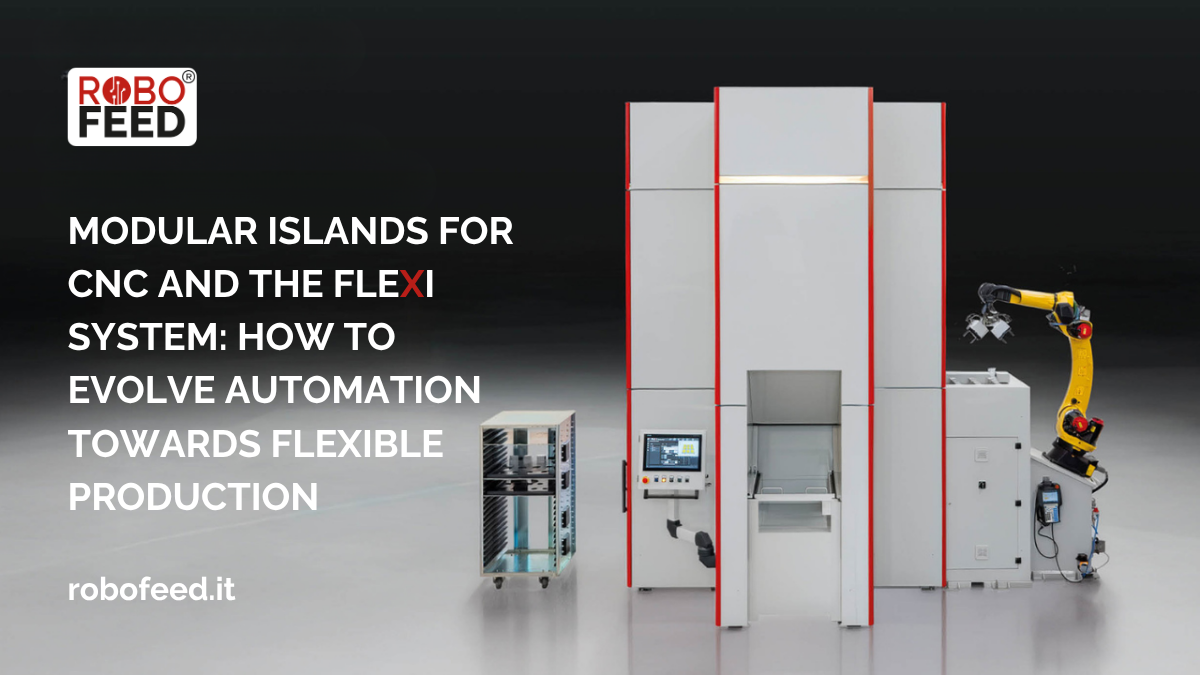
ROBO FEED FLEXI is not a robotic cell, but a machine designed as a centralised intelligent production management system, combining vertical storage, automated handling and integration with robots and CNC machine tools.
ROBO FEED FLEXI is an autonomous machine that integrates with industrial robots and CNC machines to enable a flexible, automated production system:
- industrial robots (Fanuc)
- intelligent vertical storage
- advanced multi-product production management
- proprietary software for complete process control
The aim is clear: to make industrial automation and robotics truly adaptable to complex production environments.
FLEXI Architecture: the intelligent vertical storage system at the service of production
At the heart of the FLEXI system is an architecture based on load units (trays) and an automated handling system.
The trays can hold:
- raw and processed pieces
- pallet
- equipment
- gripping systems (grippers)
- tools and accessories
Stacker crane: the heart of the machine
The system is controlled by a central three-axis stacker crane, which:
- automatically handles load units
- optimises space according to tray height
- manages operational priorities (giving priority to robotic production)
This enables smooth and intelligent management of the production flow.
Operating bays: configurable flexibility
ROBO FEED FLEXI stands out for its ability to configure different operating bays, tailored to the needs of the production line.
Robot Bay
- Direct interface with one or more Fanuc robots
- Tray handling during downtime
- Optimisation of cycle time (robot focused solely on handling)
Trolley Bay
- integration with trolleys and trays from other manufacturers
- maximum compatibility with systems already in use within the company
Operator Bay
- ergonomic workstation for:
- set-up
- workpiece changeover
- quality control
This approach allows FLEXI to fit seamlessly into any production plant, avoiding the inflexibility typical of standard solutions.
Multi-product manufacturing and advanced workflow management
One of FLEXI’s key strengths is its ability to manage multi-product scheduled production.
The system allows you to:
- work on multiple codes at the same time
- handle small, medium and large batches
- support multiple CNC machine tools (up to 4)
- to produce the finished product without the need for constant operator intervention
FLEXI does not carry out the manufacturing processes directly, but enables truly efficient industrial robotic automation by coordinating all the resources involved.
ROBO FEED software: the brain of the system
The proprietary software developed by ROBO FEED is what really makes the machine work.
Designed to be:
- intuitive
- driven
- no programming required
It allows you to manage:
- production recipes
- operating cash flows
- integration with ERP and MES systems
Advanced features
- dynamic production scheduling
- real-time priority adjustment
- what-if simulations
- full traceability of load units
- automatic control of gripping systems and equipment
A level of control that makes FLEXI perfectly compatible with modern industrial automation and robotics systems.
Digital Twin and advanced control
A key feature is the inclusion of an integrated digital twin, which enables:
- 3D view of the machine
- real-time monitoring of operational status
- support for recipe creation
- diagnosis and fault management
A tangible benefit for those working in modern industrial robotics, where control and prediction are essential.
Robotic cells and FLEXI: two complementary elements
To truly understand the value of ROBO FEED FLEXI, it is important to clarify the relationship between this machine and traditional robotic cells designed for CNC machining.
Robotic cells are generally designed to automate specific loading and unloading operations for machine tools, focusing primarily on the handling of workpieces within a defined process.
ROBO FEED FLEXI takes this concept a step further and introduces a higher level of automation.
In addition to directly managing the control of CNC machine tools, FLEXI also centralises and coordinates:
- materials
- equipment
- gripping systems
- tools
- production flows
This means that the system does more than simply load and unload the workpiece; it intelligently organises everything required for production, making the process smoother and more autonomous.
Thanks to the centralised management of all these variables, FLEXI enables you to handle highly variable production runs, small batches and multi-stage processes more efficiently.
The result is a much more advanced level of automation compared to stand-alone solutions or those focused exclusively on a single robotic task.
The benefits of FLEXI for the production department
To the Plant Manager
- increase in productivity
- reduction in downtime
- optimisation of internal workflows
- full production traceability
- better use of space (up to 6 metres in height)
For Production Managers
- easier management of small batches and high mix volumes
- reduction in changeover times
- better production planning
- less reliance on manual tasks
For Operations Managers
- greater production scalability
- reduction of logistics waste
- optimisation of internal workflows
- improvement in the plant’s overall efficiency
FLEXI configurations
ROBO FEED FLEXI is available in various configurations:
- tray management:
- 600×400 mm (FLEXI 400)
- 600×600 mm (FLEXI 600)
- load capacity up to 70 kg per tray
- modular height with vertical extension
ROBO FEED FLEXI can be integrated with a wide range of Fanuc robot models – selected according to handling, tending and palletising requirements – such as:
- M-20iD
- M-710iC
- R-2000iC
The models mentioned are, of course, just a few examples and do not cover all the available configurations.
This allows the solution to be tailored to any requirements for machine tending robots.
FLEXI acts as a central management and supply system for the production process, coordinating materials, equipment and workflows to the robots and machine tools.
The future of CNC automation lies in intelligent workflow management
The true evolution of industrial robotic automation is not just about introducing robots, but about the ability to intelligently manage the entire production process.
ROBO FEED FLEXI embodies this change:
- from rigid to flexible automation
- from manual operation to automatic control
- from isolated systems to integrated ecosystems
This transformation is currently at the heart of the debate in the world of robotics and industrial automation, where there is a growing need for solutions capable of adapting to increasingly dynamic production processes. We have also discussed this evolution in this in-depth article on the future of motion control.
An approach that fits perfectly with the development of the modern Italian robotics industry.
Would you like to find out how to integrate a FLEXI system into your production line?
The ROBO FEED team supports companies in designing bespoke CNC automation solutions, starting with a thorough analysis of their production requirements.
Contact ROBO FEED for technical advice and find out how to transform your production process with a truly flexible system.
FAQ
No, it is a machine that manages materials and production flows by integrating with robots and CNC machines.
It is used to coordinate production, manage equipment and materials, and optimise CNC automation.
Yes, it can be integrated with various Fanuc robot models.
Up to 4 CNC machine tools.
Yes, it is designed to handle multi-product manufacturing and high variability.