


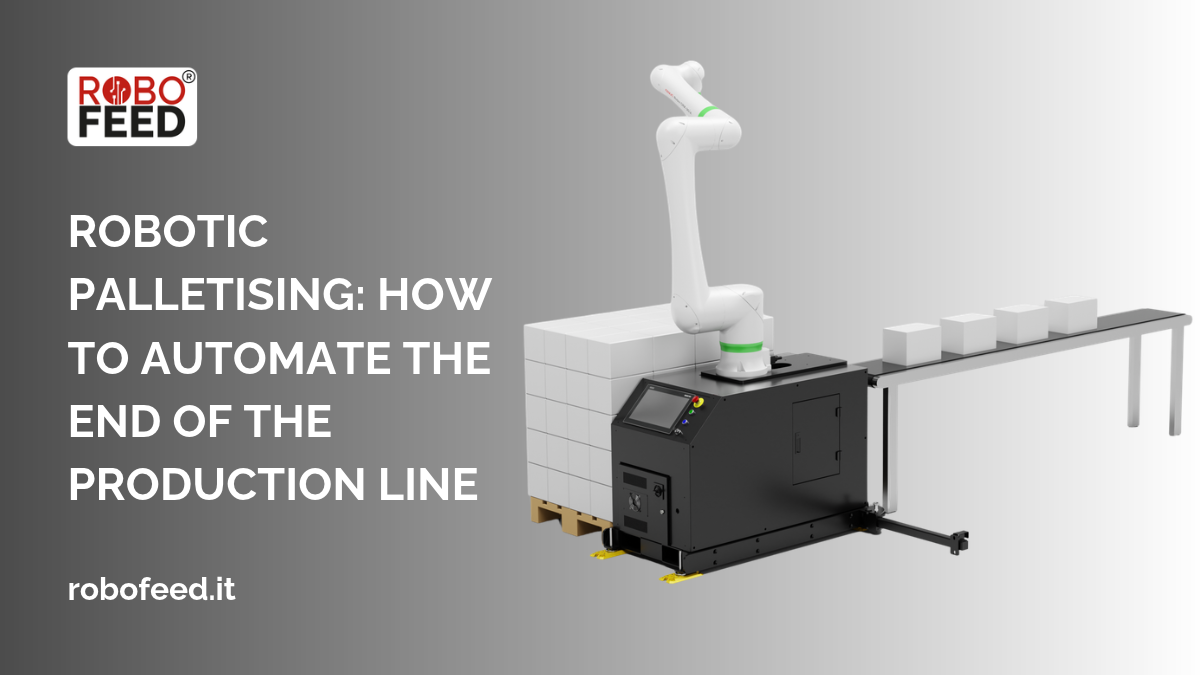
Palletising is one of the final operations in the production process, but it can have a significant impact on the efficiency of the entire line. When products are placed onto pallets manually, handling times, the repetitive nature of the operations and operator availability can affect the continuity of production.
Robotic palletising enables this stage to be automated using systems capable of picking up products from the production line and arranging them on pallets according to predefined stacking patterns.
The aim is not only to reduce manual tasks, but also to ensure a smoother flow between production and logistics, improving the repeatability of operations and allowing operators to focus on higher value-added activities.
The introduction of compact and flexible robotic solutions now makes it possible to consider this type of automation even on existing production lines, with configurations that can be adapted to the characteristics of the products and the available space.
Indice dei contenuti
ToggleWhat is robotic palletising and how does it work?
Robotic palletising is an automated process that uses an industrial or collaborative robot to pick up products and place them onto a pallet in a programmed sequence.
The system generally operates at the end of the production line, following processing, packaging or packing operations.
The cycle may involve several stages:
- arrival of the product at the picking station;
- detection of product availability;
- picking using a suitable gripper system;
- handling towards the pallet;
- placement according to the specified stacking pattern;
- repetition of the cycle until the pallet is complete.
Operation depends on the integration between the robot, the gripping system, the handling devices and the management software.
The choice of configuration must take into account not only the weight of the products, but also their dimensions, geometry, load stability and the frequency of format changes.
Robotic palletising solutions can be configured to handle different products, formats and stacking patterns. FANUCexplores the main applications of automated palletising and the technologies used to adapt handling to end-of-line requirements.
The role of the gripping system
The gripping system is one of the most important elements of the application.
Depending on the product, different technologies may be used, including suction cup systems or other gripping devices designed to handle the load without compromising its integrity.
The choice must take into account the product’s surface, its rigidity, its weight and the conditions under which the picking operation is carried out.
A correctly sized gripping system contributes to cycle repeatability and positioning accuracy.
Palletising patterns
The palletising pattern defines the arrangement of products across the various levels of the pallet.
It must be designed taking into account the dimensions of the packaging, the weight distribution, the expected height and the overall stability of the load.
The ability to store different patterns allows for the handling of different products and formats, reducing the need to manually reprogramme each sequence.
What are the benefits of robotic palletising?
The automation of end-of-line operations can help to improve various aspects of the production process.
One of the main benefits relates to operational continuity. Manual palletising requires staff to be constantly available and can act as a bottleneck when the pace of production increases.
A robotic system, on the other hand, allows repetitive operations to be carried out with consistent methods and sequences, provided the cell’s capacity is adequate for the incoming product flow.
A second benefit relates to the standardisation of pallets. The robot positions the products according to a defined pattern, helping to reduce misalignments and stacking errors.
A regular arrangement can also facilitate subsequent handling, storage and transport operations.
Ergonomics and reduction of manual handling
Palletising operations can involve frequent lifting, repetitive movements and the handling of loads throughout the entire shift.
Automation reduces the need for direct operator involvement in these tasks.
Whilst this does not eliminate the need to manage plant safety correctly, it does allow for a rethinking of work organisation, entrusting the repetitive picking and placing operations to the robotic system.
Flexibility in handling different formats
Production lines do not necessarily handle a single format.
Boxes, crates, containers and packaged products can vary in size and characteristics, requiring specific palletising patterns.
For this reason, the ability to manage multiple recipes and call them up quickly is an important consideration when choosing an automated solution.
Industrial robots and collaborative robots in palletising
Palletising applications can be carried out using traditional industrial robots or collaborative robots, depending on the characteristics of the process.
Industrial robots are generally chosen when the application requires specific performance in terms of payload, speed or productivity.
Collaborative robots, or cobots, can be an attractive alternative for applications requiring a compact footprint, flexibility and interaction with operators.
However, the choice does not depend solely on the type of robot.
The following factors must be assessed:
- total weight of the load and the gripper;
- reach required to access the placement positions;
- height and configuration of the pallet;
- number of products to be handled per unit of time;
- available space;
- methods of feeding and removing pallets;
- safety requirements of the application.
It is also important to distinguish between a collaborative robot and a collaborative application.
The presence of a cobot does not automatically make any configuration safe. Operating modes, speeds, tools and the loads being handled must be assessed through a risk analysis of the entire application.
Depending on the operating conditions, protective devices and additional safety measures may therefore be required.
For further information on safety aspects relating to robotic systems, please refer to INAIL’s guidelines on functional safety.
How to design an automated palletising cell
The design of a palletising cell must begin with an analysis of the production process and the characteristics of the products to be handled.
It is not enough simply to choose a robot with an adequate payload. It is necessary to ensure that the entire solution can be integrated into the production line flow without introducing new issues.
Analysis of the production flow
The first factor to consider is the quantity of products reaching the end of the line.
The cell’s cycle time must be compatible with the production rate, whilst also taking into account any variations in product size, stoppages and operations required to replace full pallets.
If the palletising capacity is lower than the incoming flow, the system may become a new bottleneck.
Layout and integration with the production line
The position of the cell must be determined by taking into account the available space, material handling routes, accessibility and the tasks carried out by operators.
Integration may require belt conveyors, roller conveyors, centring systems and devices for detecting or identifying products.
A correctly designed layout enables the coordination of feeding, picking and depositing operations, whilst ensuring that the areas required for management and maintenance remain accessible.
Format Changeover Management
When the line produces different items, the system must be able to adapt the handling sequences and stacking patterns.
Management via recipes allows the information required to carry out the intended cycle to be associated with each product.
The effectiveness of format changeover also depends on the compatibility of the gripping system with the various products and on the simplicity of the operator interface.
ROBO FEED C3-P: a collaborative solution for end-of-line palletising
Among the solutions designed for end-of-line automation, the ROBO FEED C3-P is a collaborative robotic cell designed to automate palletising operations.
The system is designed to pick up boxes, containers, crates, bundles and packaged products, arranging them on pallets according to configurable stacking patterns.
The solution utilises a FANUC CRX-30iA/L collaborative robot, with a wrist payload of 30 kg and a reach of 1,756 mm.
The compact design makes it possible to assess integration into both new plants and existing production lines, taking into account the available space and the characteristics of the process.
Management software and palletising recipes
One of the distinctive features of the C3-P is the management software developed by ROBO FEED, designed to simplify interaction between the operator and the robotic system.
Via a multi-touch HMI interface, the operator is guided through the management of the cell without having to intervene directly in the robot’s programming.
The system allows different palletising recipes to be stored and recalled, adapting the cycle to the characteristics of the products and the required layouts.
Product master data and production flows can also be managed on the machine itself or imported from external ERP/MES systems, depending on the level of integration implemented.
Configuration and integration into the end-of-line process
The C3-P is designed to be integrated into the production flow via a configuration that can be adapted to the requirements of the application.
The available components include various gripping systems, motorised roller conveyors, belt conveyors, barcode and QR code readers, centring systems and product tilting devices.
The cell also features floor-mounted anchor points that facilitate the correct positioning and any repositioning of the system.
For the configuration shown in the technical data sheet, the effective stacking height on a 1,200 × 800 mm Euro pallet reaches 2,000 mm.
These features allow the solution to be tailored to the product, the layout and the operating procedures of the end-of-line process.
Discover all the features of ROBO FEED C3-P, our solution for automatic end-of-line palletising.
When is it advisable to automate palletising?
The introduction of a robotic palletising system must be assessed in light of the company’s production and organisational requirements.
It can be particularly beneficial when:
- the end-of-line process requires frequent manual lifting and placement operations;
- production volumes make it necessary to maintain a constant pace;
- there are different formats to manage;
- there is a desire to improve the uniformity of the pallets;
- it is necessary to reduce repetitive tasks for operators;
- the aim is to integrate the end-of-line process with automation and production management systems.
The cost-benefit analysis must take into account not only the investment cost, but also the time spent on manual handling, the required productivity, staff availability and the characteristics of the process.
Automatic palletising is therefore not a one-size-fits-all solution for every company, but a system that must be tailored to actual production requirements.
Robotic palletising as part of the production process
Automating palletising involves optimising a stage that directly links production, internal handling and logistics.
To achieve an effective result, it is necessary to consider the entire process: from the arrival of the product at the picking station through to the completion and management of the pallet.
The selection of the robot, the gripper system, the software and the handling equipment must therefore be addressed as part of an integration project.
With the new ROBO FEED C3-P, ROBO FEED’s expertise in industrial automation now extends to end-of-line palletising operations, through a collaborative solution designed to combine flexibility, ease of management and operational continuity.
Would you like to explore the possibility of automating palletising on your production line?
Contact ROBO FEED to analyse product specifications, available space and the configuration best suited to your process.