




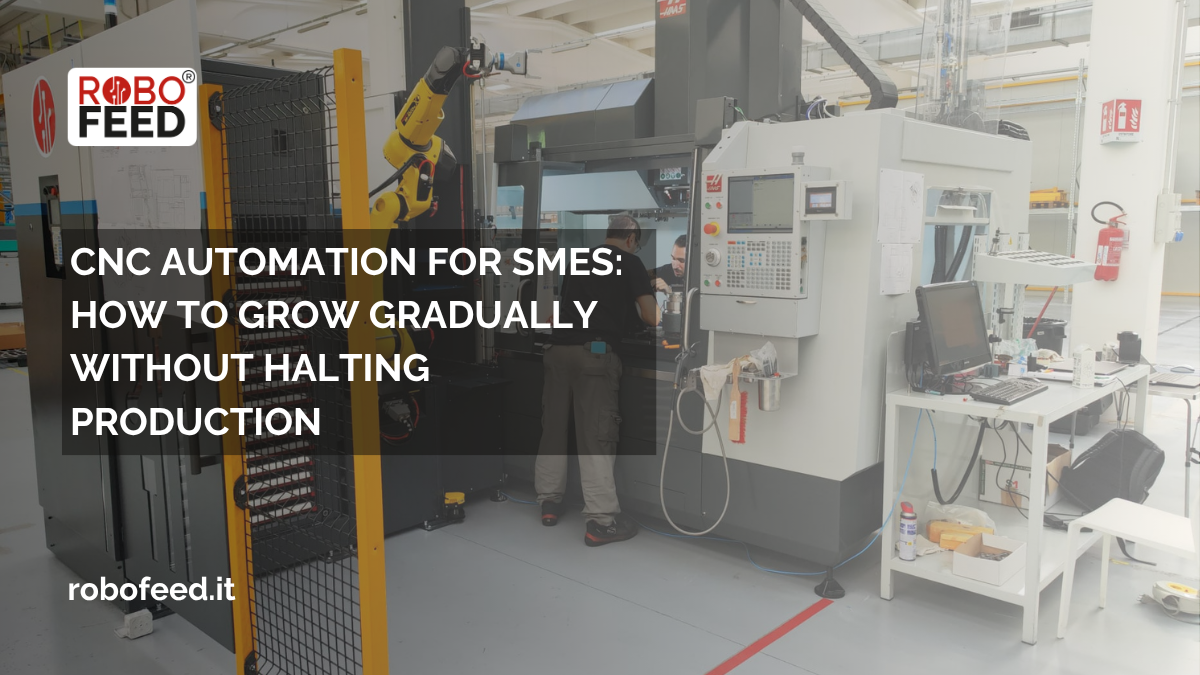
CNC automation for SMEs is no longer the preserve of large industrial plants or excessive investment. Today, even small and medium-sized manufacturing companies can introduce robotics and automation in a gradual, sustainable manner that is, above all, compatible with their existing production processes.
The question is no longer ‘whether to automate’, but where to start without taking any risks and without bringing the factory to a standstill.
And it is precisely this principle that underpins the ROBO FEED approach.
Indice dei contenuti
ToggleThe real problem facing SMEs: productivity under pressure
Many engineering firms find themselves in a very real situation today:
- difficulty in finding specialist staff
- increase in labour costs and shift work
- the need to increase output without expanding the plant
- competitiveness that is increasingly on a par with highly automated operations
Against this backdrop, the automation of machine tools is not merely a ‘technological upgrade’, but a genuine strategic lever for maintaining profit margins and production continuity.
Automation does not mean revolutionising: it means getting off to a good start
One of the most common mistakes is to think of CNC automation as a comprehensive and immediate project.
In the context of SMEs, this approach often acts as a barrier.
The most effective approach is a different one: gradual and modular automation.
This means:
- starting with a single CNC machine
- automate only one critical stage (e.g. loading/unloading parts)
- assess the actual impact on production
- to gradually extend to other machines
Automation is not a leap into the unknown, but a step-by-step process that needs to be implemented gradually in order to maximise its effectiveness.
Compact robotic cells: automation without halting production
Modern, compact robotic cells are one of the most effective solutions for SMEs.
Unlike large traditional plants, they enable:
- to be integrated into existing CNC machines
- to minimise changes to the production plant
- to maintain business continuity during installation
- to make the most of the available space in the workshop
This approach makes it possible to introduce robotics and industrial automation without disrupting factory operations.
Industrial robots, cobots and CNC control systems: what do you really need?
In the world of industrial robotics, there are various solutions, but not all of them are suitable for every production context.
The main options include:
- industrial robots for repetitive tasks and high speeds
- collaborative robots (cobots) for human-machine interaction
- CNC machine tool handling systems for automatic loading and unloading
In many CNC applications, the most effective choice is a dedicated servo system, designed to ensure continuity, precision and reduced downtime.
The ROBO FEED approach: automation designed with SMEs in mind
The ROBO FEED model is based on a clear principle: there is no one-size-fits-all automation solution, but rather a bespoke approach for every business.
The solutions include:
- modular cells for CNC automation
- integration with industrial robots and cobots
- scalable systems ranging from single machines to multiple installations
- gradual expansion without halting production
This enables SMEs to approach investment in a sustainable manner, linking it directly to real growth in production.
In practice: you don’t buy a fixed system, but build a scalable one.
Where do SMEs that successfully automate actually start?
The most successful companies never start with complex projects.
They always start from a simple premise:
- analysis of the existing production cycle
- identification of the most critical CNC machine
- assessment of downtime (loading/unloading, waiting times, set-up)
- introduction of the first compact robotic cell
- measuring return on investment
This is the best way to validate the automation directly in the field before rolling it out.
Reducing risk: the real benefit of gradual automation
For an SME, the real challenge is not just to increase productivity, but to do so without operational risks.
ROBO FEED solutions are designed to:
- to be integrated into existing systems
- to avoid prolonged machine downtime
- starting with a single production unit
- expand only after the results have been validated
The reason? To reduce what is, in most cases, perceived as the main barrier to investment: the fear of halting production.
CNC Automation and ROI: Return on Investment
The introduction of CNC automation systems brings measurable benefits right from the outset:
- increase in effective machine time
- reduction in repetitive manual tasks
- greater consistency in process quality
- the ability to operate extended shifts without a proportional increase in costs
In many cases, automating a single CNC cell can be a turning point for a company’s profit margins.
The evolution of industry: humans and robots on the same production line
Modern industry does not replace the worker, but redefines their role.
The combination of:
- soft skills
- industrial robotics
- CNC automation
- digital process control
It is creating a new, more efficient and stable production model.
True transformation is not the ‘factory without people’, but a factory where people work on activities that add greater value.
Would you like to know where to start when it comes to automating your CNC production?
Every business has different constraints, layouts and objectives. That is why the first step is not to buy a machine, but to work out where automation can have the greatest real impact.
Request a technical analysis of your production cycle with ROBO FEED
We can help you assess:
- which CNC machine to automate first
- which solution is compatible with your system
- What improvements in productivity can you achieve right from the first stage?
A simple, practical and no-obligation first step, designed to help you make a decision based on real data from your production.