




In CNC mechanics, increased productivity no longer depends solely on optimizing the machine cycle, but on the intelligent integration of machine tools and robotic automation.
CNC machine automation is currently one of the most effective solutions for transforming a traditional machine into an automated, scalable production cell that is ready to operate even without continuous supervision.
But what exactly is enslavement? How can a robot be properly integrated with a CNC? And what are the fundamental elements in designing an efficient automated cell?
Indice dei contenuti
ToggleWhat does CNC mean?
Before discussing enslavement, it is necessary to clarify a fundamental concept: what is CNC?
CNC stands for Computer Numerical Control. A CNC machine is a machine tool (lathe, machining center, milling machine, grinding machine, etc.) that performs mechanical machining operations using digitally programmed instructions.
The CNC manages:
- Movements of the axes
- Spindle rotation speed
- Progress
- Operating sequences
- Tool changes
- Process parameters
Compared to traditional machines, CNC offers:
- Repeatability
- Micrometric precision
- Automation of the manufacturing cycle
- Reduction of human error
But there is a structural limitation: the machine only works when it is fed with pieces.
And this is where enslavement comes into play.
What is machine subservience?
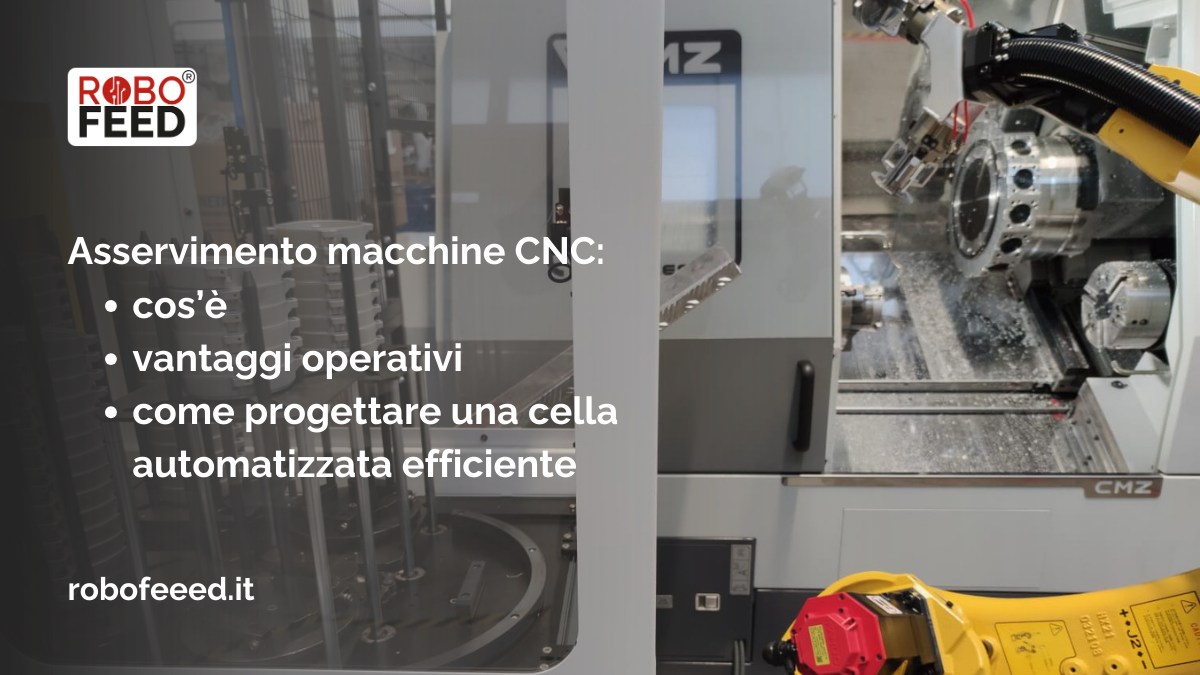
Machine tending is the integration of an automatic system that manages the loading and unloading of parts on a CNC machine tool, making the process continuous and autonomous.
In other words:
Slave control is what allows the CNC machine to operate without an operator dedicated to manual loading.
CNC subservience is mainly achieved through:
- 6-axis anthropomorphic robots
- Cobots (collaborative robots)
In both cases, the robot interacts directly with the machine tool, managing the loading and unloading of parts in synchronization with the CNC cycle.
In the modern industrial context, when we talk about CNC servo robots, we are referring to an integrated solution in which the robot:
- Pick up the raw piece
- Put it in the machine.
- Wait for the end of the cycle
- Get the finished piece
- If necessary, place it on a conveyor belt, pallet, or quality control area.
There is only one goal: to increase OEE (Overall Equipment Effectiveness).
Why subservience is a strategic choice today
Asservitude is no longer an option for large industrial groups.
It is also a competitive advantage for mechanical SMEs.
1. Increase in real productivity
An unattended CNC machine:
- Works only when operator is present
- There are downtimes between cycles.
- Stops during breaks or unattended shifts
A subservient machine:
- Can work 24 hours a day
- Drastically reduces downtime
- Stabilizes cycle times
2. Reduction in operating costs
Subjugation:
- Reduces repetitive labor
- Minimizes loading errors
- Reduces waste from incorrect positioning
- Allows operators to be reassigned to higher-value activities
3. Improved safety
The robot eliminates:
- Repetitive manual handling
- Ergonomic risks
- Exposure to chips and rotating parts
4. Process standardization
A well-designed servo system guarantees:
- Consistent repeatability
- Cycle traceability
- Integration with MES / Industry 4.0 systems
CNC servo robots: which solutions to adopt?
In the context of CNC machine tool servo systems, the most common solutions are:
6-axis anthropomorphic robot
This is the most widely used for CNC servo systems, thanks to:
- High flexibility of movement
- Ability to operate on multiple machines
- Adaptability to different workpiece formats
- Easy integration with existing layouts
It is ideal for medium-high production and for companies with a variable production mix.
Cobot (collaborative robot)
Suitable for:
- Compact integrations
- Shared environments with operators
- Progressive investments
- Applications with low payloads
The cobot is a scalable and flexible solution, particularly suitable for SMEs embarking on a path toward automation.
How to design a servo cell: basic architecture
This is where the most critical aspect comes into play: design.
A common mistake is to think that simply “adding a robot” is enough.
In reality, servo control is an integrated system.
1. Preliminary process analysis
Before designing, the following must be evaluated:
- Machine cycle time
- Loading/unloading time
- Required takt time
- Annual volumes
- Part variability
- Department layout
This phase is strategic and often underestimated.
2. Definition of the architecture
A standard servo cell includes:
- CNC machine
- Robot
- Customized gripper
- Vision system (if necessary)
- Raw material warehouse
- Finished product storage area
- Integrated electrical panel
- PLC/CNC interface
3. Software integration
Crucial element:
communication between CNC and robot.
Required:
- Cycle synchronization
- Alarm signaling
- Emergency management
- Safety logic
This is where technical experience makes the difference.
4. Safety and regulations
A servo cell must comply with:
- Machinery Directive
- Risk assessment
- Perimeter protection systems
- Optical barriers or scanners
The most common mistake in CNC robotics
Many companies focus solely on the robotics component.
But the real critical point is integration with the machine tool.
The most common mistake is to underestimate the design phase of robotics integration.
A robot chosen without a thorough analysis of cycle times, layout, and flows can create bottlenecks instead of eliminating them.
Robotic arm control is not about “adding a robot,” but rather designing an automated cell consistent with production objectives.
The importance of robotic integration in the design of a servo cell
In CNC servo systems, the robotic component is not an accessory, but the heart of the cell architecture.
Proper design means:
- Analyzing actual cycle times
- Correctly defining payload and kinematics
- Developing customized grippers
- Ensuring stable CNC–robot communication
- Optimizing layout and logistics flows
An effective servo system is the result of integrated mechanical, electrical, and software design.
In this context, the experience of an integrator specializing in automation for machine tools becomes crucial to ensuring reliability, scalability, and ROI on the investment.
When is it worth investing in a CNC control system?
Enslavement is particularly recommended when:
- Manual loading times exceed 15–20% of the cycle
- Multiple shifts are worked
- Volumes are stable
- There is a shortage of qualified operators
- You want to grow without increasing staff
The economic analysis must include:
- ROI
- Operator cost reduction
- Increase in annual production
- Industry 4.0/5.0 incentives (if applicable)
Machine tending: not just automation, but industrial strategy
CNC tending is not simply a robot that loads parts.
It is:
- Process optimization
- Reduction of inefficiencies
- Mechanical + software integration
- Advanced production planning
Companies that approach the project with a systemic vision achieve:
- Greater competitiveness
- Production stability
- Future scalability
Proper machine tending design also allows the cell to be modular and ready for future expansion, such as integration with palletized systems or multi-machine management.
Conclusion
CNC machine automation is not simply a technological upgrade: it is a strategic choice that redefines the production model.
A well-designed robotic cell increases productivity, stabilizes processes, and prepares the company for structured growth.
The difference lies not only in the robot, but in the quality of the design and the integration between the machine tool and the automation system.
Transform your CNC machine into a high-performance automated cell.
A robot is not enough. You need an integrated project.
ROBO FEED designs and manufactures complete CNC servo systems:
- Robot-machine tool integration
- Layout and flow study
- Custom gripper development
- PLC integration and CNC communication
- Modular and scalable solutions
Discover how much you can increase productivity without increasing staff.
Contact us for a customized feasibility study.
Machine tending is an automation system that automatically manages the loading and unloading of parts on a CNC machine tool. It can be implemented using anthropomorphic robots, cobots, gantries, or palletized systems, allowing the machine to operate without continuous operator supervision.
CNC stands for Computer Numerical Control. It is the technology that allows a machine tool to perform mechanical machining operations using programmed digital instructions, ensuring precision, repeatability, and control of process parameters.
A CNC servo robot allows you to:
-increase productivity up to 24-hour operation
-reduce downtime between cycles
-improve operator safety
-reduce loading errors
-stabilize OEE
The main benefit is production continuity.