




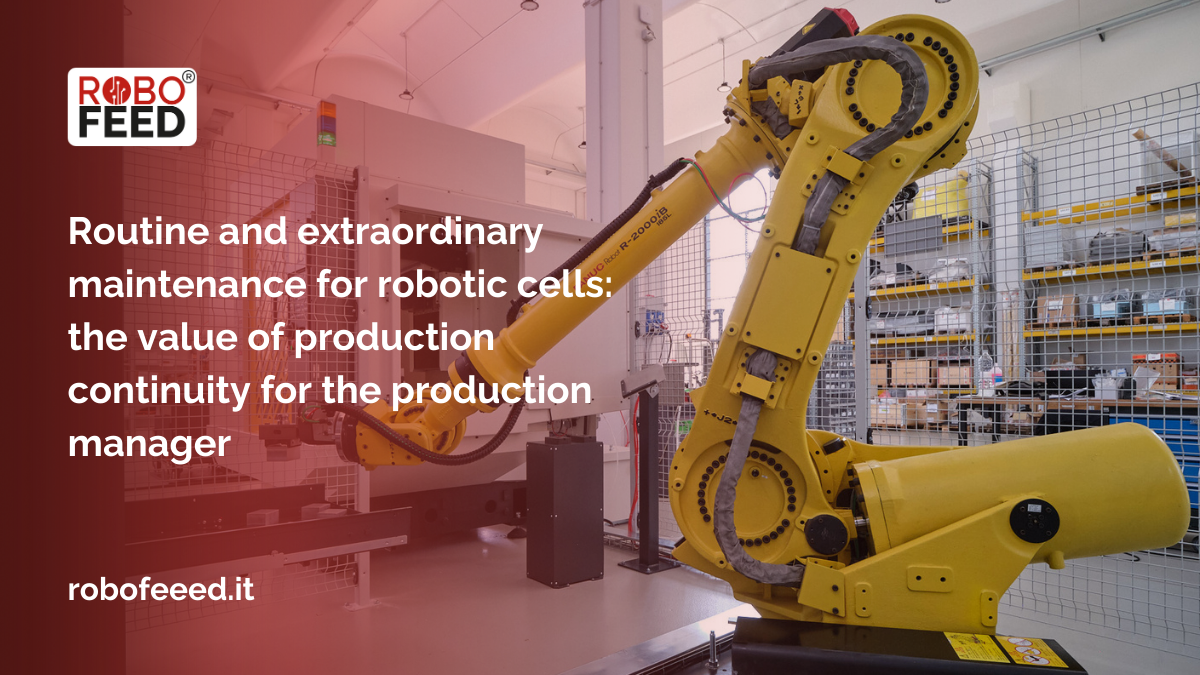
In the world of industrial production, where precision and speed are everything, robots are now the beating heart of automated lines. But if technology is the mind of the system, maintenance is what guarantees its longevity.
Today, talking about routine and extraordinary maintenance for robotic cells no longer means just dealing with ‘technical assistance’: it means planning for production continuity, reducing risks and protecting the value of the investment.
In this context, ROBO FEED’s robotic assistance division stands out for its structured and forward-looking approach, combining the know-how inherited from Assistec in the CNC world with advanced expertise in industrial and collaborative robotics.
Indice dei contenuti
ToggleRobotic maintenance: not an ‘extra’, but a pillar of production
Every minute of machine downtime in an automated plant has a measurable cost, often a high one. Yet even today, many companies tend to underestimate the strategic impact of planned maintenance.
Routine and extraordinary robotic assistance enables production managers to maintain control over operational efficiency, reducing unexpected breakdowns and extending the useful life of systems.
Routine maintenance: prevention before repair
Routine maintenance covers all activities that preserve the robot’s functionality over time. In the case of ROBO FEED, this includes:
- Replacement of lubricants and inspection of gearboxes;
- FANUC system safety checks;
- Checking wiring and batteries;
- Cleaning and ventilation of electrical panels;
- Backup software, useful for managing future interventions and updates.
Interventions of this type guarantee stability, security and traceability of operations: three fundamental factors for those who supervise automated production with a view to Industry 4.0 and Industry 5.0.
Extraordinary maintenance: re-engineering to evolve
Extraordinary maintenance, on the other hand, comes into play when the system requires more extensive work: a retrofit, functional restoration or software and hardware overhaul.
ROBO FEED offers services ranging from the replacement and wiring of grippers, sensors and actuators to the refurbishment of electrical cabinets, the overhaul of safety circuits and integration with company databases or IT systems.
In other words, this is a genuine technological upgrade, which keeps the system aligned with Industry 4.0 standards and makes it more flexible, reliable and compliant with current regulations.
Two real-life examples demonstrating the value of robotic assistance
In the industrial landscape, talking about maintenance is important. But it is through results that a production manager can truly assess its value.
Here are two exemplary projects carried out by the ROBO FEED team on robotic islands with FANUC robots, demonstrating how technical expertise and a systemic vision can make all the difference.
Case history 1 – Retrofit of a robotic cell for Alumat
The requirement:
Alumat, a company specialising in the production of dies for aluminium extrusion, was faced with a common but complex problem: a robotic cell that had been in operation for over 15 years, with obsolete software, missing documentation and limited manufacturer support.
Security was compromised, the system could no longer be integrated with the new IT infrastructure, and the risk of machine downtime was growing day by day.
The intervention:
The ROBO FEED team designed a complete retrofit intervention, retaining as much of the existing hardware as possible to keep time and costs down. The following were carried out:
- the refurbishment of the electrical cabinet,
- the replacement of safety circuits,
- the redesign of control software, compatible with Industry 4.0 logic,
- the complete reconstruction of the technical documentation, in just three days.
The result:
Production was halted for just one night.
Today, the cell operates with modern, open and integrable software, with certified safety standards and more transparent management of process data. A prime example of how extraordinary maintenance can be transformed into sustainable digital evolution.
Case history 2 – Restoration of a robotic island with FANUC robots
The requirement:
CMO, a company in the hydraulic sector, had a robotic cell installed but never actually operational. The system, consisting of FANUC robots, a CNC machine tool, a rack storage system and a parts washing station, experienced continuous robot cycle stoppages due to sensors unsuitable for the environment and parts positioning errors.
The intervention:
ROBO FEED carried out a functional analysis of the island and identified the causes of the malfunctions.
- A new gripper system with IP insulation suitable for the working conditions has been installed;
- The parts warehouse has been redesigned, with the addition of flat springs for precise and stable positioning.
The result:
The robotic island is now fully operational again without the need for a complete overhaul of the system. A targeted intervention that has restored productivity and safety, maximising the value of the investment already made.
What a production manager should ask themselves before choosing a robotic assistance service
The choice of a partner for robotic maintenance cannot be based solely on price or speed of response.
A production manager must evaluate broader parameters related to the company’s industrial vision and technical expertise.
Here are some key questions:
- What is the average response time and how is availability guaranteed?
- Does the company offer integrated remote and on-site support?
- Is it possible to plan preventive maintenance interventions with dedicated reports?
- Is the service compatible with FANUC robots and 4.0 systems?
- Are regular software updates and security backups provided?
Answering these questions means establishing a long-term relationship, where assistance is not a cost but a strategic lever for production stability.
Robotic assistance as a competitive factor for Italian industry
Today, Italy ranks second in Europe in terms of the spread of collaborative robots, with steady growth in investment in automation. In this context, routine and extraordinary robotic maintenance is a key factor in supporting the competitiveness and resilience of businesses.
Investing in a structured service such as ROBO FEED means:
- reduce machine downtime and unexpected maintenance costs;
- maintain high standards of safety and compliance;
- ensure operational continuity even on older systems;
- promote the digital integration of production processes.
It is an approach that transforms robotic assistance into a strategic investment in the future of the plant, rather than a simple expense item.
Conclusion
The routine and extraordinary maintenance of a robotic system is much more than a technical intervention: it is a strategic choice of industrial governance.
For the production manager, this means being able to rely on a robotic line that is always efficient, safe and ready to face the challenges of global competitiveness.
ROBO FEED proves this every day, with concrete actions, measurable results and know-how that comes from direct experience in the field.
Would you like to discover how to plan a robotic maintenance programme tailored to your company?
Contact the ROBO FEED team for a personalised assessment: production continuity begins with quality support.